News
We don’t expect success, we work for it. Become a part of an amazing team!

The AI Supercycle and the New Mandate for Infrastructure Leadership
North American telecommunications providers are standing at a decisive threshold. Economic pressure has tightened margins, while technological acceleration has compressed timelines for change. The next decade will not reward incremental adjustments; it will reward structural transformation.
What is driving this urgency is not a single innovation, but a broader shift in how intelligence is embedded into digital ecosystems. The rise of artificial intelligence is simultaneously altering traffic patterns, computing requirements, network architectures, and infrastructure economics. This is not a cycle of upgrade. It is a cycle of redesign.
AI Is Rewriting Network Demand
Artificial intelligence workloads do not behave as traditional data flows. They require extreme throughput, low-latency coordination, and synchronized performance across distributed compute environments.
As AI infrastructure expands, so does the need for specialized connectivity layers:
-
High-capacity back-end networks linking clustered compute environments.
-
Intelligent front-end connectivity supporting workload distribution
-
Expanded data center interconnection across regions
-
Power-dense facilities and reinforced energy distribution systems
This shift creates exponential demand for high-performance fiber networks, resilient power delivery, and disciplined execution at scale.
Infrastructure providers that recognize this demand early will not simply respond to it; they will help to shape it.
The Era of Manual Operations Is Ending
In an AI-driven environment, operational fragmentation becomes a liability. Networks supporting advanced workloads cannot depend on disconnected spreadsheets, delayed reporting cycles, or siloed coordination.
The future demands integrated visibility across engineering, materials, field execution, and financial oversight. Automation is not a marketing term in this context. It is a prerequisite for reliability.
Organizations that embrace end-to-end coordination will deliver faster builds, tighter cost control, and more predictable performance outcomes.
Architectural Transformation Is No Longer Optional
Legacy architectures were designed for human-paced decision-making and linear growth in traffic. AI systems generate nonlinear demand spikes, requiring dynamic resource allocation.
This reality forces a fundamental question: should networks be patched to accommodate new requirements, or rebuilt with intelligence embedded into their design?
Leaders are choosing transformation over extension. They are rethinking topology, data center placement, redundancy models, and operational oversight to align with future scale rather than past patterns.
Utilities One Group supports this evolution by enabling disciplined execution across fiber expansion, wireless infrastructure, power distribution, and fulfillment services. Strong architecture requires equally strong field delivery.
Capital Must Be Deployed With Precision
The AI supercycle is attracting unprecedented levels of capital into digital infrastructure, but capital alone does not create advantage; strategic allocation does.
Investment decisions now center on:
-
Geographic positioning for data center growth
-
High-density fiber corridors
-
Energy resilience and grid upgrades
-
Deployment models that reduce build cycle time
Execution capacity becomes a differentiator. The ability to mobilize crews, coordinate multi-state projects, and maintain quality under compressed timelines determines whether capital converts into operational capability.
Ecosystem Alignment Defines Market Leaders
No organization operates in isolation during this transition. Carriers, hyperscalers, utilities, municipalities, and infrastructure partners are tightly interdependent.
The next generation of leaders will be those who align their strategies across this ecosystem. Transparent communication, shared planning, and coordinated deployment frameworks accelerate progress while reducing friction.
Empowering industry transformation means enabling this collaboration at the operational level, not just the strategic level.
Five Strategic Imperatives for the AI Era
To remain competitive in the AI supercycle, telecom and infrastructure leaders must commit to decisive action:
-
Redesign networks for intelligence native performance
-
Integrate operational systems for real-time visibility.
-
Expand execution capacity aligned with data center growth.
-
Strengthen energy and fiber resilience across regions.
-
Align partnerships to accelerate deployment and innovation.
The Decade Will Be Defined Now
The AI supercycle is not a forecast; it is unfolding in real time. Data center construction is accelerating. High-density fiber builds are expanding. Energy demand is intensifying.
Organizations that treat this moment as a temporary surge will struggle. Those who recognize it as a structural transformation will lead.
Utilities One Group stands positioned within this evolution, empowering infrastructure initiatives that support high-performance connectivity, resilient energy systems, and disciplined execution across complex markets.
The next decade belongs to those who build for intelligence, not just bandwidth.
Share Via:
Related Posts
13 January, 2026
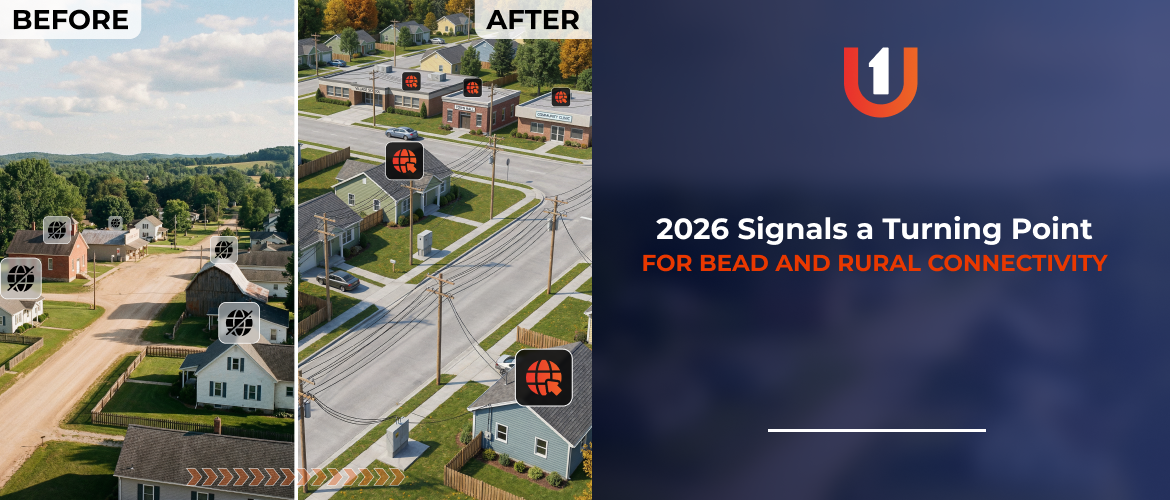
2026 Signals a Turning Point for BEAD and Rural Connectivity
This article highlights how the BEAD Program is entering a critical deployment phase in 2026, expanding broadband access in rural and underserved communities and outlining Utilities One Group’s role in delivering high-impact infrastructure projects.

18 December, 2025
Behind the Scenes: End of Year Work and Welcoming 2026
At Utilities One Group, this time is used to bring people together, recognize the work done throughout the year, and prepare operations for the months ahead. The goal is simple: enter 2026 aligned, ready, and focused on delivering reliable infrastructure.
300 W Somerdale Rd, Suite 5E, Voorhees Township, NJ 08043
COPYRIGHT © 2026 UTILITIES ONE